TV Deals Calendar: When to Buy for the Best Price
TV prices follow a predictable annual rhythm. Buy during the right week and you can save 20-40% on the same model that costs full price a month later. Buy at the wrong time and you will overpay for technology that is about to be replaced. This calendar maps every major sales window so you know exactly when to pull the trigger.
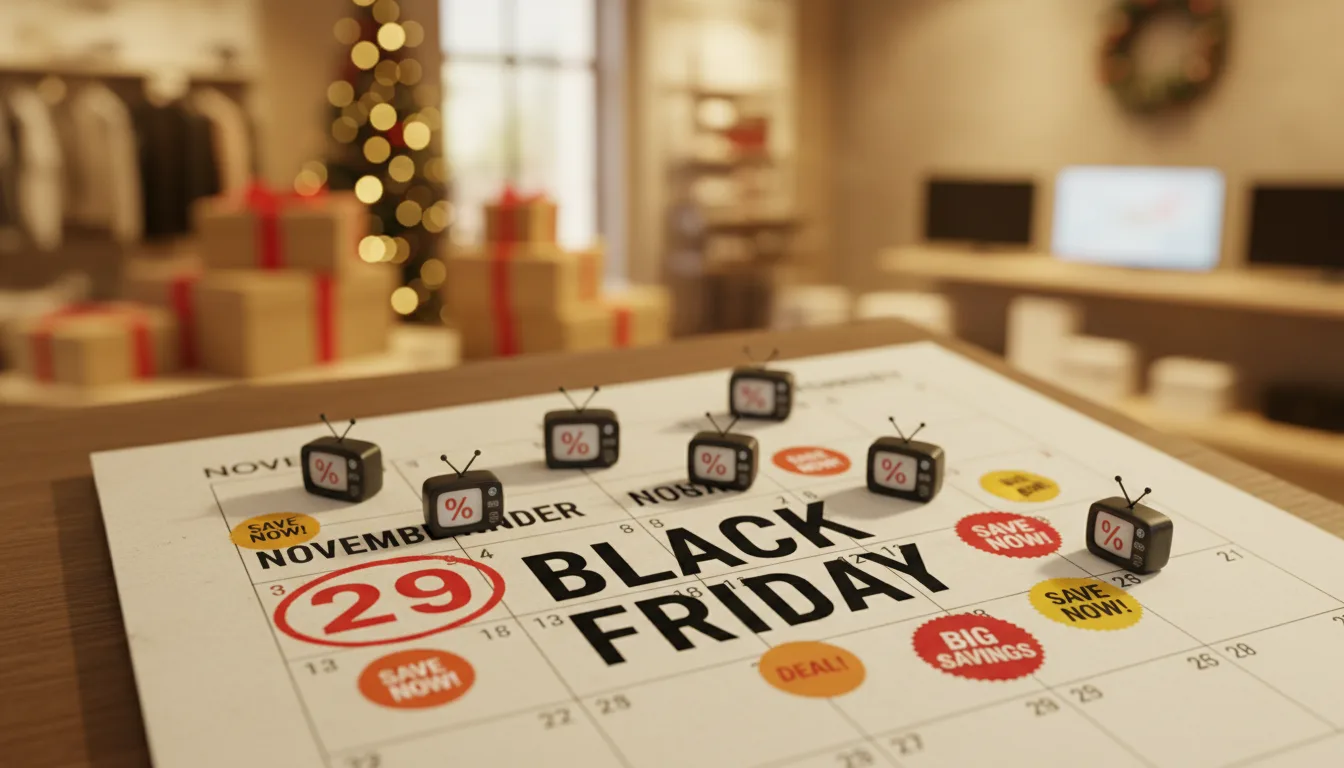
The Annual TV Pricing Cycle
TV pricing is not random. It follows a pattern driven by two forces: retailer sales events and manufacturer model-year transitions. Understanding both tells you not just when to buy, but what to buy at each point in the year.
New TV models typically announce at CES in January, ship between March and June, and reach full retail availability by midsummer. As new models arrive, outgoing models drop in price. By Black Friday, the current year's lineup is mature and aggressively discounted, while closeout models from the previous year hit their lowest prices before disappearing from shelves entirely.
Month-by-Month Breakdown
January - February: Super Bowl Sales (Save 15-25%)
Retailers push large-screen TVs hard in the weeks before the Super Bowl. Big screens -- 65 inches and up -- see the deepest cuts because the marketing angle is game-day viewing parties. Deals typically appear 2-3 weeks before the game, not on game day itself.
This is a strong window for budget and mid-range big-screen models. Premium TVs like OLED see modest discounts at best. If you want a 75" for the living room, late January through early February is a reliable window.
Presidents' Day weekend (mid-February) brings a brief secondary sales window. Discounts are real but modest -- typically 10-15% on select models. Worth checking but not worth planning around.
Best categories: Budget LED 65-75", mid-range QLED 65-75"
Skip for now: OLED and premium Mini-LED (much better deals come later in the year)
March - May: Model Transition Season (Save 20-35% on Outgoing Models)
This is where the smart money buys. New 2026 models start shipping, and retailers slash prices on outgoing 2025 inventory to clear shelf space. The outgoing models are excellent TVs -- they were flagships just weeks ago.
The LG C4 at closeout pricing is a textbook example: it delivers roughly 90% of the newer C5's performance at a real discount, simply because it is being replaced by the next generation.
Memorial Day (late May) adds a retailer sales event on top of the natural clearance cycle, creating a double-discount window for outgoing models.
The closeout strategy: Identify the model you want from the outgoing year and set a price alert on CamelCamelCamel. When the replacement model ships, the outgoing version's price drops within 2-4 weeks. The best closeout pricing usually appears 4-8 weeks after the new model reaches retail. Don't wait too long -- popular models sell out and do not come back.
June: Pre-Summer Lull (Avoid Buying)
The gap between Memorial Day and Prime Day. New models sit at or near full MSRP. Previous-year clearance stock is dwindling. Unless you find remaining closeout inventory, this is one of the worst times to buy a TV at standard retail pricing.
July: Amazon Prime Day (Save 20-35%)
The second-best TV buying event of the year. Amazon and competing retailers (Best Buy, Walmart, Target) all run simultaneous sales that often match or approach Black Friday pricing on popular models.
Prime Day is particularly strong for Amazon's own Fire TV lineup and for brands that sell heavily through Amazon: TCL, Hisense, Insignia. Budget models like the Insignia 55" Fire TV routinely hit their lowest-ever prices during this event. Mid-range models like the Samsung Q7F see solid discounts. Mini-LED TVs from TCL and Hisense -- including the Hisense QD7QF -- often drop below their launch pricing for the first time.
Samsung and LG participate but typically save their deepest cuts for Black Friday.
Before Prime Day, identify 2-3 target models and set a price threshold for each using their 90-day history on CamelCamelCamel. If a Prime Day deal meets your threshold, buy it -- don't gamble on Black Friday being lower for that specific model. Some models sell out before November, and Black Friday pricing is not guaranteed to beat Prime Day on every SKU.
August - September: Back to School and Labor Day (Save 10-15%)
Back-to-school sales focus on smaller, affordable TVs aimed at dorm rooms and first apartments. Budget 43-55" models see modest discounts. Larger and premium TVs are largely unaffected.
Labor Day weekend (early September) brings a brief sales event with slightly better deals -- comparable to Memorial Day in scope. Good enough if you need a TV for football season and cannot wait for Black Friday.
Best categories: Budget 43-55" LED TVs for small spaces and bedrooms
Skip: Anything above mid-range -- your patience will be rewarded in November
October: Early Black Friday Teasers
Retailers begin seeding "early Black Friday" deals in mid-to-late October. Some are genuine -- a few models hit their Black Friday price 2-3 weeks early. Amazon's October Prime Day event (Prime Big Deal Days) adds another buying opportunity with discounts comparable to the July event.
The challenge: it is hard to distinguish early genuine deals from inflated "doorbusters" designed to create urgency. Always check the 90-day price history before buying anything marketed as an "early" deal.
November: Black Friday / Cyber Monday (Save 25-45%)
The undisputed best time to buy a TV. Every brand, every retailer, every category participates. The discounts are real, deep, and widespread.
Black Friday week (the Wednesday before through Cyber Monday) delivers the highest concentration of low prices. Some doorbusters sell out quickly, but the broader discounts persist through the following week.
Black Friday by brand:
- TCL: Consistently the most aggressive discounter. Mini-LED models like the QM6K regularly drop 25-35% below their average street price.
- Hisense: Deep cuts on Mini-LED and QLED. The QD7QF and U-series see some of the biggest dollar drops of any brand.
- Samsung: Real discounts on QLED and Neo QLED. Samsung starts from higher list prices, so check the absolute price, not just the "save $X" badge.
- LG: OLED pricing drops predictably. The C5 sees its best price of the year. The C4 at closeout may hit its absolute floor if stock remains.
- Sony: The most conservative discounter. Rarely more than 15-20% off, even on Black Friday. If you want Sony, this is still the best time -- just temper expectations.
- Insignia / Roku / Amazon: Budget and house brands hit rock-bottom doorbuster pricing.
December: Holiday and Post-Christmas (Save 15-25%)
Post-Black Friday holiday pricing remains competitive through mid-December as retailers chase gift purchases. Discounts are genuine but generally 5-10% less aggressive than Black Friday week. By late December, prices normalize.
The days after Christmas sometimes bring clearance pricing on specific models retailers want to move before year-end inventory counts. Worth checking if you missed Black Friday, but selection is limited to remaining stock.
Which Brands Discount the Most?
TCL and Hisense: The Discount Leaders
Both brands compete aggressively on price year-round and discount even further during sales events. TCL's Mini-LED lineup (QM6K, QM7K, QM8K) and Hisense's U-series see 25-40% drops during Prime Day and Black Friday. These are genuine discounts from already-competitive base prices -- not inflated markdowns from artificially high MSRPs.
Samsung: Big Banners, Check the Math
Samsung runs constant promotions with large "$X off" banners. But Samsung starts from higher prices than competitors with equivalent specs. A Samsung QLED "discounted" to mid-range pricing may still cost more than a TCL Mini-LED at full price. Always compare the final absolute price against competing models, not just the discount percentage.
LG: Predictable OLED Trajectory
LG OLED pricing follows a reliable curve: full price at launch (March-April), gradual decline through summer, first real drop at Prime Day, best price at Black Friday, and closeout pricing on the outgoing model from the following spring. The LG C5 will follow this exact trajectory through 2026 and into 2027.
Sony: Modest and Infrequent
Sony protects pricing more carefully than any other major TV brand. Expect 10-20% off during Black Friday and Prime Day, with minimal discounts the rest of the year. Sony does not compete on price -- the brand competes on processing quality and calibration accuracy.
Average Savings by Sales Event
| Sales Event | Budget LED | QLED | Mini-LED | OLED |
|---|---|---|---|---|
| Super Bowl (Jan-Feb) | 15-25% | 10-20% | 10-15% | 5-10% |
| Memorial Day (May) | 10-20% | 10-20% | 10-20% | 10-15% |
| Prime Day (July) | 20-35% | 20-30% | 20-35% | 15-25% |
| Back to School (Aug-Sep) | 10-15% | 5-10% | 5-10% | 5-10% |
| Black Friday (Nov) | 25-45% | 25-40% | 25-40% | 20-30% |
Percentages represent typical discounts from 90-day average street price, not from inflated MSRP. Actual savings vary by model, size, and retailer.
Smart Buying Strategies
Strategy 1: The Closeout Play
Wait for the new model-year announcement, then buy the outgoing version at closeout pricing. You get 85-95% of the new model's performance at 60-75% of the price. The LG C4 at closeout is the poster child for this approach -- a flagship OLED at a fraction of C5 pricing.
Risk: Popular models sell out. Once a closeout model is gone, it does not come back. Set alerts and act when the price is right.
Strategy 2: The Prime Day Commit
Set your price threshold before Prime Day using 90-day price history, and buy immediately if a deal meets it. Don't gamble on Black Friday being lower for your specific model -- some SKUs sell out before November, and Black Friday pricing is not guaranteed to beat Prime Day on every model.
Strategy 3: The Black Friday All-In
Wait for Black Friday for the absolute lowest prices across the board. Best for buyers who are flexible on the exact model -- if your first choice sells out, alternatives will also be deeply discounted. This strategy works best for budget and mid-range TVs where multiple competitive models exist at each price point.
Strategy 4: The Open-Box Angle
Check Best Buy's open-box inventory and Amazon Warehouse after major sales events. Returns from Black Friday and Prime Day create a wave of open-box units in December and August, often 15-30% below the already-discounted sale price. Most retailers offer the same return policy on open-box as new.
Before any sale, check the 90-day price history on CamelCamelCamel (Amazon) or Google Shopping's price comparison. A "40% off" badge means nothing if the reference price was inflated two weeks before the sale. The real question: is this the lowest price in the last 90 days? If yes, it is a genuine deal.
Avoid these timing mistakes:
- Buying in February-March at full price -- new models are about to ship, making current inventory overpriced.
- Buying a "sale" without checking price history -- inflated reference prices are common before major sales events.
- Waiting past January for closeout models -- once remaining stock sells out, it does not come back at any price.
- Assuming all Black Friday TVs are deals -- some "doorbuster" models are stripped-down variants made specifically for Black Friday with worse specs than the regular model. Always verify specs.
Extended Warranties: Worth It?
Retailers push extended warranties hardest during sales events. For most TVs, skip them. Manufacturer warranties cover defects for the first year, and TVs that survive the first 90 days rarely fail within 3-5 years.
The exception: LG OLED TVs. If burn-in concerns factor into your thinking and you plan to keep the TV 5+ years, an extended warranty with burn-in coverage provides genuine peace of mind. But LG's standard manufacturer warranty already covers burn-in for the first several years on current models -- check the coverage period before paying for additional protection. See our burn-in guide for the full picture on OLED durability.
Frequently Asked Questions
When is the absolute best time to buy a TV?
Black Friday and the week surrounding it consistently delivers the deepest discounts of the year across all brands and categories. If you can wait until late November, you will almost certainly get a better price than any other time. Amazon Prime Day in July is the second-best option, with deals that often match or approach Black Friday pricing on select models.
Are Super Bowl TV deals actually good?
Yes, but they are more targeted than Black Friday. Retailers push big-screen TVs (65 inches and up) in late January and early February because shoppers are thinking about game-day viewing. The discounts on large screens are genuine -- typically 15-25% off. Smaller sizes and premium models often see better prices during Prime Day or Black Friday.
Is it cheaper to buy last year's TV model?
Almost always. When new model-year TVs launch (typically March through June), outgoing models drop in price as retailers clear inventory. The LG C4 at closeout pricing is a textbook example -- it delivers roughly 90% of the C5 experience at a meaningful discount. The best closeout pricing appears 4-8 weeks after the replacement model ships.
Which TV brands have the biggest sales?
TCL and Hisense are consistently the most aggressive with promotional pricing, offering deep cuts on Mini-LED models during sales events. Samsung runs frequent promotions but from higher starting prices, so the percentage off can be misleading. LG OLED pricing drops predictably around Prime Day and Black Friday. Sony rarely discounts aggressively -- their sales tend to be the most modest of any major brand.
Should I buy a TV on Amazon Prime Day or wait for Black Friday?
If you find a TV at your target price on Prime Day, buy it. Prime Day deals on TVs are often within 5-10% of Black Friday prices. The risk of waiting is that specific models may sell out or be discontinued by November. If no Prime Day deal meets your price threshold, waiting for Black Friday is the safer bet for the absolute lowest price of the year.
Do TV prices go up before Black Friday to make deals look bigger?
Some retailers inflate list prices in the weeks before Black Friday, making the discount percentage appear larger than it is. Use a price tracking tool like CamelCamelCamel (for Amazon) or Google Shopping price history to verify the actual price trajectory. The best deals are actually lower than the 90-day average -- but not every advertised percentage is honest.
Are refurbished or open-box TVs a good deal?
Open-box TVs from Best Buy and Amazon Warehouse can save 15-30% and typically come with the same return policy as new units. Refurbished units are riskier -- warranty coverage varies and you cannot inspect the panel for uniformity issues before purchase. For OLED specifically, we recommend new or open-box only, since panel health is harder to verify on refurbished stock.
Ready to Find Your TV?
Now that you know when to buy, figure out what to buy. Our complete TV buying guide walks through every decision -- screen size, panel type, smart features, and budget allocation. Or browse our resource hub for reviews, roundups, and comparisons across every category and price tier.