TCL 65" T7 Mini-LED 144Hz Smart Google TV Review 2026
Slotting between TCL's budget QM6K and premium QM7K, the T7 refines the Mini-LED formula with improved processing at a modest price step. Incremental gains, not a revolution.
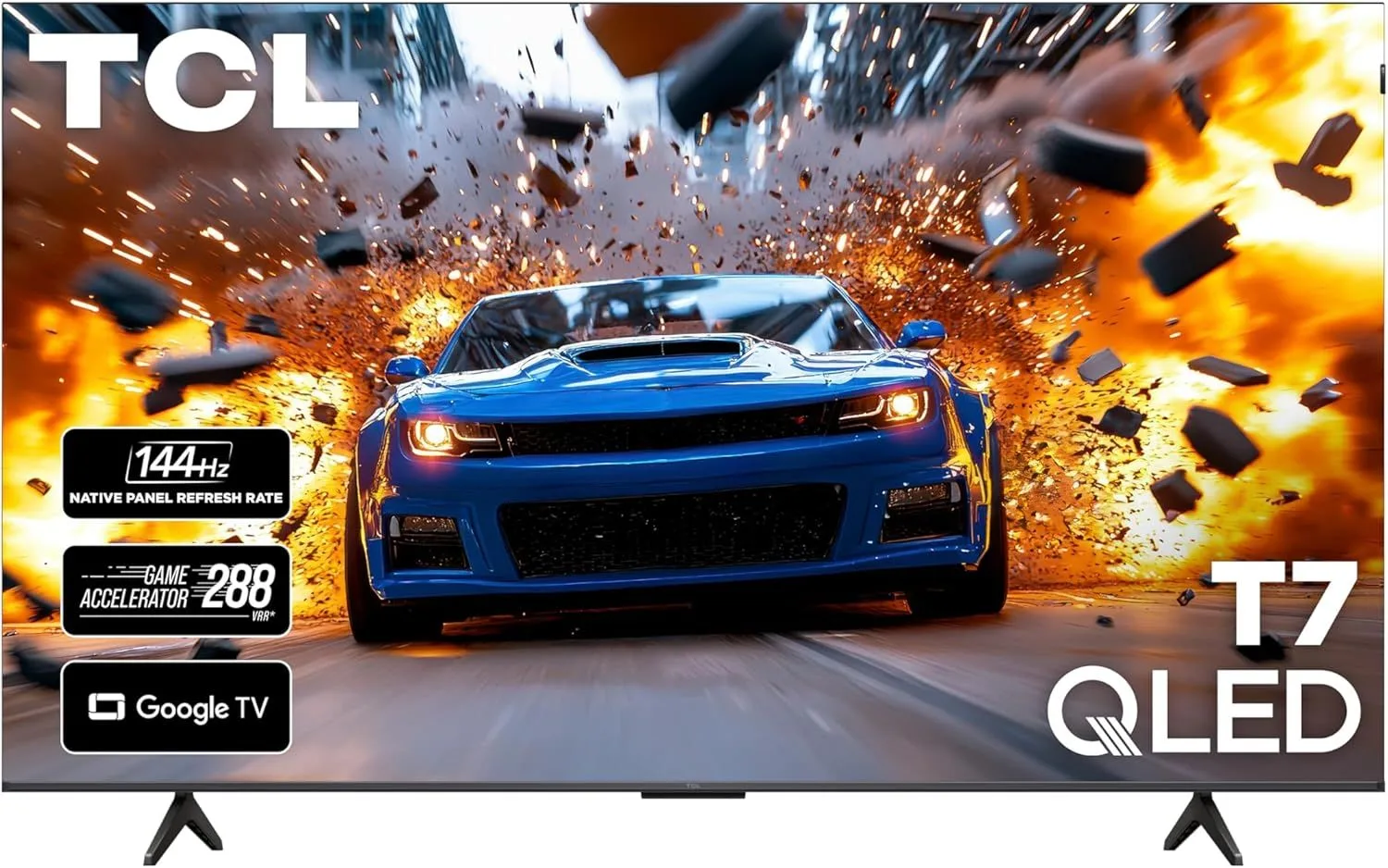
The T7 slots between TCL's QM6K and QM7K, offering improved processing and slight brightness gains. Worth the step up from QM6K if the price difference is modest.
The Middle Child of TCL's Mini-LED Lineup
TCL's Mini-LED tier structure at 65" runs QM6K, T7, QM7K. The QM6K is the value champion. The QM7K is the performance pick. The T7 occupies the middle ground — same approximate zone count and brightness as the QM6K, but with an improved processor that handles HDR tone mapping, shadow detail, and motion interpolation more capably.
At $500–$800, the price premium over the QM6K is modest. Whether that premium is justified depends on how much you notice processing refinements — which, honestly, many viewers will not.
Better Processing, Same Panel
The T7's processor advantage shows up in three specific scenarios. First, HDR tone mapping in dark scenes preserves more shadow detail — faces lit by firelight, objects in dimly lit rooms, details in cave sequences. Second, color gradients in sky scenes and skin tones show fewer visible steps. Third, motion handling during fast camera pans is slightly more controlled, with less judder in 24fps film content.
These are real improvements. They are also subtle. Side-by-side with the QM6K, you can spot the differences. In isolation, most viewers would not identify the T7 as being processed differently. The panel hardware — brightness, zones, contrast ratio — is the primary driver of picture quality, and that hardware is essentially identical between the two.
Set the picture mode to "Filmmaker Mode" for movies and "Game" for gaming. Avoid the "Dynamic" mode, which pushes the processor to over-sharpen and over-saturate — counteracting the very processing improvements that differentiate the T7 from the QM6K.
144Hz Gaming: Same Capability as the QM6K
Gaming performance is essentially identical to the QM6K tier. Two HDMI 2.1 ports, 144Hz with VRR, ALLM, and low input lag in Game Mode. If gaming is your primary motivation, the T7 does not add anything over the QM6K in this department. Save the difference or put it toward a better headset.
What Works
- ✓144Hz gaming with VRR and ALLM
- ✓Improved processing over QM6K tier
- ✓Google TV with Chromecast built-in
Cons
- ✗Price premium over QM6K for incremental improvement
- ✗Blooming still present in dark scenes
- ✗Sound quality is average for the price
Google TV: Familiar Territory
The same Google TV experience as the QM6K. Comprehensive app library, Chromecast built in, Google Assistant voice search. The interface is content-rich and occasionally ad-heavy. It works well once configured, but the setup process involves more decisions than Roku's streamlined approach.
QM6K, T7, or QM7K?
This is the core question for any buyer considering the T7. The QM6K at a lower price delivers nearly identical hardware with slightly less refined processing. The QM7K at a higher price doubles the zone count and adds AIPQ PRO processing for a substantial leap in dark-room performance.
The T7 makes sense if the QM6K is out of stock or the price gap is minimal. It does not make sense if you can stretch to the QM7K — that jump delivers far more visible improvement per dollar than the QM6K-to-T7 step.
Frequently Asked Questions
What is the difference between the TCL T7 and QM6K?
The T7 uses an improved processor over the QM6K, which results in slightly better HDR tone mapping, shadow detail recovery, and motion handling. The zone count and brightness are comparable. The T7 is the "refined" version of the QM6K tier — same hardware foundation, better software processing.
Is the TCL T7 better than the Samsung Q7F QLED?
For picture quality, yes. The T7 is a Mini-LED with hundreds of dimming zones, 144Hz, and Dolby Vision — all features the Samsung Q7F lacks. The Samsung wins on design aesthetics and the Tizen ecosystem. If picture quality is your priority, the T7 outperforms the Q7F decisively.
Does the TCL T7 have good sound quality?
Average for its tier. The 20W speakers handle dialogue and casual viewing fine, but movie watchers and gamers will want a soundbar. At this price point, no TV delivers impressive audio — budget for a separate sound solution.
How does the TCL T7 handle blooming?
Blooming is present in the same scenarios as the QM6K — bright objects on dark backgrounds. The improved processing on the T7 handles zone transitions slightly more gracefully, reducing the "halo" effect around bright elements. It is an incremental improvement, not a dramatic one.
Should I get the T7 at 65" or the QM6K at 75"?
If your seating distance supports 75" (8-10 feet), the bigger QM6K delivers more immersive viewing. If your room suits 65", the T7 offers slightly better processing per pixel. Both are strong choices — the decision is really about screen size versus processing quality.
Final Verdict
Rating: 4.3/5
The T7 slots between TCL's QM6K and QM7K, offering improved processing and slight brightness gains. Worth the step up from QM6K if the price difference is modest.
A refined version of an already excellent formula. The T7 is a solid TV — just make sure you are not paying a significant premium over the QM6K for gains that only processing enthusiasts will notice.