Roku 65" Pro Series QLED Smart TV (2025) Review 2026
The rare TV that gets both picture quality and ease of use right. Roku's Pro Series proves you do not have to choose between simplicity and performance.
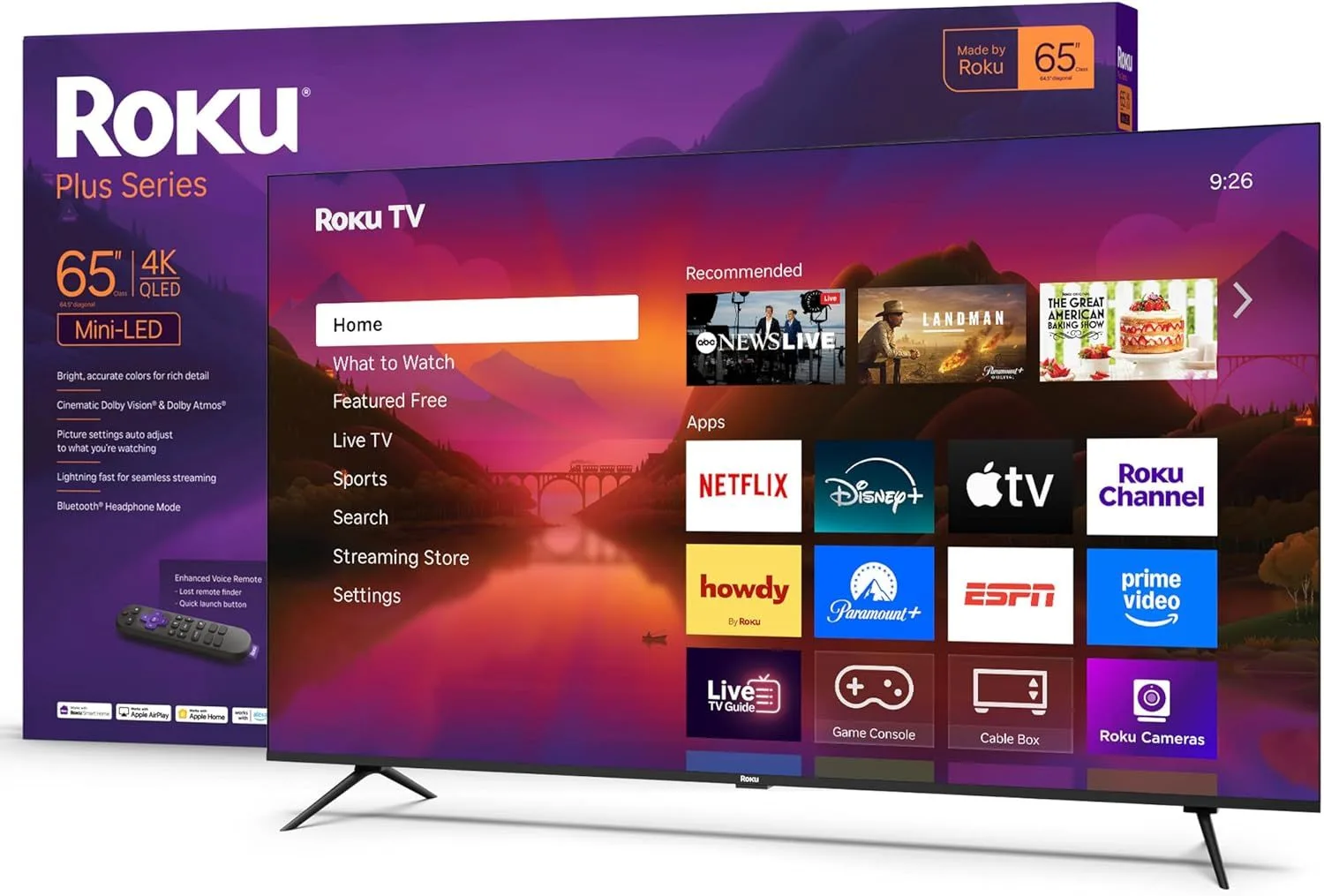
The Roku Pro Series is the rare TV that excels at both picture quality AND ease of use. Local dimming and 120Hz at this price, combined with Roku's simplicity, make it a standout.
Simplicity as a Feature
Every TV manufacturer obsesses over picture specs. Roku obsesses over something different: can everyone in the household actually use this thing?
The Pro Series is the answer. Roku OS boots in seconds, the home screen is a clean grid of apps without sponsored clutter, and the remote has a fraction of the buttons found on Samsung or LG remotes. Your parents can use it. Your kids can use it. Your visiting in-laws who struggle with their own TV can use it.
What makes the Pro Series special is that this simplicity comes paired with genuinely good hardware. QLED color. Full-array local dimming. 120Hz with VRR. Dolby Vision. At mid-range for its category pricing, these are flagship-adjacent specs wrapped in the most approachable interface on the market.
Local Dimming Changes the Game
Full-array local dimming at this price is unusual for a QLED, and it makes a tangible difference. Dark movie scenes have genuine depth instead of the washed-out gray that plagues edge-lit competitors like Samsung's Q7F. Stars against a night sky render as bright points on deep black, not bright points surrounded by gray haze.
The QLED layer adds color volume that basic LED panels cannot match. Combined with Dolby Vision and HDR10+ dual support, the picture quality covers all the bases. It is not Mini-LED performance, and peak brightness trails Samsung's brighter panels. But for a QLED at this price, the total package is remarkably complete.
If your TV serves a mixed household — kids who want cartoons, parents who stream movies, grandparents who watch news — the Roku Pro is the best choice under $700. Everyone can navigate Roku OS without help. The picture quality satisfies the pickier viewers. And Apple AirPlay means iPhone users can cast content without learning the remote.
Gaming: Quietly Capable
Roku does not market the Pro Series as a gaming TV, but the specs tell a different story. Two HDMI 2.1 ports support 4K 120Hz with VRR and ALLM. Input lag in Game Mode is competitive. Two consoles can connect at full speed simultaneously.
Roku OS itself lacks advanced gaming features like Samsung's Gaming Hub or LG's Game Dashboard. There is no cloud gaming integration. But for plugging in a PS5 or Xbox and playing at 120fps with low latency and local dimming, the Pro Series delivers.
Strengths
- ✓Full-array local dimming with QLED — unusual at this price
- ✓120Hz with VRR for gaming
- ✓Roku's clean, ad-light interface with Apple AirPlay
Weaknesses
- ✗Roku OS lacks advanced customization options
- ✗Limited peak brightness vs Samsung and TCL flagships
- ✗Smaller app selection than Google TV
Apple AirPlay: The Unsung Advantage
Apple AirPlay 2 and HomeKit support give the Roku Pro a quiet advantage in Apple households. Cast content from your iPhone without installing anything. Control the TV with Siri. Add it to your HomeKit scenes. Fire TV does not offer this. Samsung and LG do, but their interfaces are more complex.
For households where iPhones are standard, AirPlay on Roku OS is the smoothest casting experience available. Tap, cast, watch. No accounts to link, no apps to install, no pairing process.
The Value Equation
At $300–$500, the Roku Pro packs more features per dollar than Samsung's Q7F (which lacks local dimming and Dolby Vision) and delivers a cleaner interface than Amazon's Omni QLED (which adds ads at every turn). The trade-off is lower peak brightness and a platform that sacrifices advanced customization for simplicity.
For multi-generation households, first-time TV buyers, or anyone who values a clean experience over feature lists, the Roku 65" Pro Series is the best mid-range TV at this price.
Frequently Asked Questions
Is the Roku Pro Series the best mid-range TV for non-technical users?
Yes. Roku OS is the simplest smart TV platform available, and the Pro Series pairs it with strong picture quality — QLED with local dimming, 120Hz, Dolby Vision. No other TV at this price combines ease of use with this feature set.
How does the Roku Pro compare to Samsung Q7F at 65"?
The Roku Pro adds full-array local dimming, Dolby Vision support, and dual HDMI 2.1 ports — all features the Samsung Q7F lacks. The Samsung wins on design and Tizen ecosystem. For pure picture quality per dollar, the Roku Pro is the better buy.
Does Roku OS have all the major streaming apps?
All major services are available: Netflix, Disney+, Hulu, HBO Max, Amazon Prime, Apple TV+, Peacock, Paramount+. The Roku Channel adds free ad-supported content. The app library is slightly smaller than Google TV but covers everything mainstream viewers need.
Can I use Apple AirPlay with the Roku Pro?
Yes. Apple AirPlay 2 and HomeKit are built in. You can stream content from your iPhone, iPad, or Mac directly to the TV, and control it with Siri. This is a significant advantage for Apple households over Fire TV alternatives.
How bright is the Roku Pro compared to Samsung QLEDs?
The Roku Pro has lower peak brightness than Samsung Q8F and TCL flagship QLEDs. In a bright room with lots of windows, Samsung and TCL panels maintain better visibility. The Roku Pro performs best in rooms with moderate or controllable lighting.
Final Verdict
Rating: 4.4/5
The Roku Pro Series is the rare TV that excels at both picture quality AND ease of use. Local dimming and 120Hz at this price, combined with Roku's simplicity, make it a standout.
Buy it for the best combination of picture quality and ease of use at this price. Skip it if you need maximum brightness for a sun-drenched room or want advanced gaming features.