Hisense 65" U75QG Mini-LED 144Hz Smart Google TV Review 2026
Around 800 dimming zones, 1800 nits, and 144Hz gaming at upper mid-range pricing. Hisense packs flagship specs into a price bracket that undercuts Samsung and Sony by hundreds.
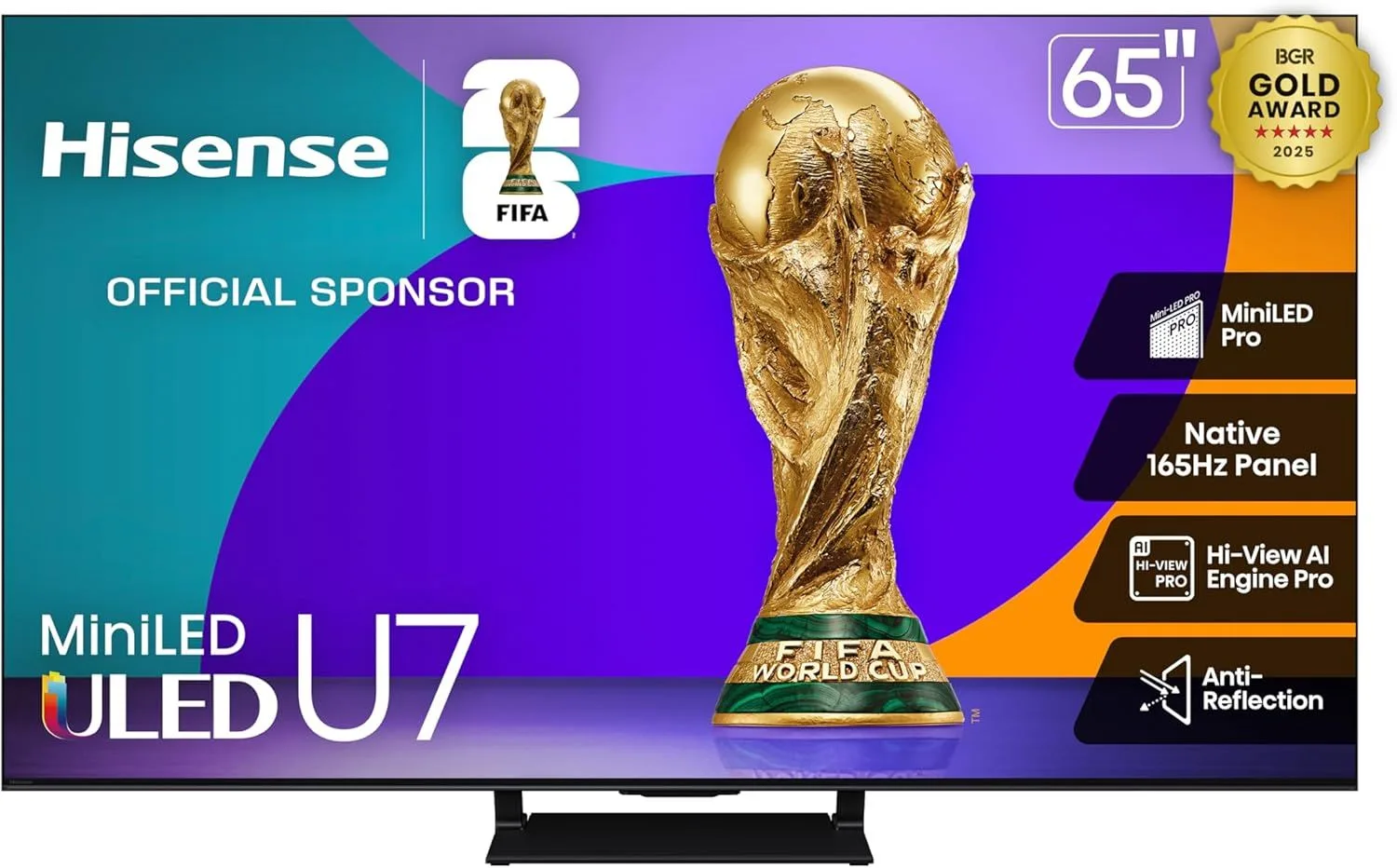
Hisense's U75QG delivers flagship-adjacent specs at upper mid-range pricing. The brightness and zone count are genuinely impressive — the trade-off is viewing angles and processing refinement.
Specs That Punch Above the Price
The U75QG's spec sheet reads like a flagship TV. Around 800 local dimming zones deliver precise backlight control. Peak brightness around 1800 nits drives HDR content with genuine intensity. 144Hz refresh with VRR and dual HDMI 2.1 ports handle next-gen console gaming without compromise. Dolby Vision and HDR10+ cover every streaming format.
At $500–$800, these specifications directly challenge TVs from Samsung and Sony that cost significantly more. The Samsung 65" QN70F and the TCL 65" QM7K are the closest competitors — and neither clearly outperforms the U75QG on paper.
Brightness and Contrast in the Living Room
Watching Dolby Vision content on a bright afternoon, the U75QG maintains HDR impact where lesser TVs wash out. Sun-drenched scenes in nature documentaries retain highlight detail. Neon signs in night cityscapes glow against dark buildings with minimal blooming. The 800-zone backlight is precise enough that most content looks clean and controlled.
Blooming is present in torture-test scenarios — a single white cursor on a black desktop, a single bright star against deep space. In these edge cases, the backlight halo is visible. During actual movie and TV show viewing, the zone count is high enough that blooming rarely intrudes. This is a real improvement over the 300-500 zone Mini-LEDs in the tier below.
Set local dimming to "High" and enable the "Shadow Detail" enhancer for dark-room movie sessions. The higher zone aggression delivers deeper blacks, and the shadow detail setting recovers crushed near-black gradients — a combination that gets the most from Dolby Vision HDR in dimmed environments.
A Serious Gaming Monitor in Disguise
Two HDMI 2.1 ports running 4K at 144Hz with VRR. Input lag in Game Mode drops below 8ms. The combination of high brightness and local dimming means HDR games look spectacular — ray-traced reflections in Cyberpunk 2077, the vivid worlds of Ratchet and Clank, the atmospheric lighting in Alan Wake 2. Gaming on the U75QG is genuinely enjoyable.
Dolby Vision gaming on Xbox Series X is an added bonus that Samsung cannot offer. For PS5 owners, VRR and 120Hz support cover the essential features, though PS5 does not support Dolby Vision gaming.
Strengths
- ✓High dimming zone count with excellent brightness
- ✓144Hz gaming with HDMI 2.1
- ✓Dolby Vision and HDR10+ for maximum format support
Cons
- ✗Narrow viewing angles typical of VA panel
- ✗Processing trails Sony and Samsung flagships
- ✗Some shadow detail loss in very dark scenes
Where the Compromises Land
Viewing angles are the U75QG's most visible weakness. The VA panel delivers stunning contrast from the center seat but loses saturation and shifts colors when viewed from more than 30 degrees off-axis. In a wide living room where people watch from couches on either side, the edge viewers will see a noticeably different picture than the person in the center.
Processing refinement — the subtle art of tone mapping, motion handling, and upscaling — trails the best from Sony and Samsung. The U75QG can occasionally crush shadow detail in very dark scenes, and film-grain handling is not as refined as Sony's BRAVIA 9 or Samsung's NQ8 processor. These are differences that calibration enthusiasts will notice. Most viewers will not.
U75QG vs. the Competition
Against the TCL QM7K: comparable zones and brightness, with TCL offering slightly better blooming control and Hisense offering dual HDR format support. A toss-up depending on your priorities.
Against the Samsung QN70F: Samsung wins on anti-reflection and wide viewing angles. Hisense wins on zone count, brightness, Dolby Vision, and price. For bright rooms with wide seating, Samsung. For everything else, the Hisense delivers more.
Against the LG OLED C5: fundamentally different technologies. The OLED wins on blacks, response time, and viewing angles. The U75QG wins on brightness, HDR highlight intensity, and cost. Both are excellent at their respective strengths.
Frequently Asked Questions
How does the Hisense U75QG compare to the TCL QM7K?
Both are flagship-adjacent Mini-LEDs at 65" with similar zone counts and brightness. The TCL QM7K edges ahead in processing and blooming control with AIPQ PRO. The Hisense U75QG holds its own on raw brightness and offers Dolby Vision plus HDR10+ dual support. Neither is a clear winner — it depends on whether you prioritize processing refinement (TCL) or format flexibility (Hisense).
Is the U75QG bright enough for a sunny living room?
At around 1800 nits peak brightness, the U75QG handles bright rooms well for most content. Reflections from direct sunlight are still visible — no LCD can fully compete with direct sun — but the brightness is high enough that HDR content maintains impact even with ambient light. For rooms with strong glare, Samsung QN70F anti-reflection coating handles reflections better.
Does the U75QG have narrow viewing angles?
Yes. The VA panel provides excellent contrast from the center position but loses color accuracy and brightness when viewed from side angles beyond about 30 degrees. If your seating arrangement is wide, consider the Samsung QN70F with its wide-angle technology, or an OLED with inherently wide angles.
Can I connect two consoles at 4K 120Hz?
Yes. The U75QG has two HDMI 2.1 ports that both support 4K at 144Hz with VRR. Connect a PS5 and Xbox Series X simultaneously and both will run at full capability — no need to swap cables.
Is the Hisense U75QG better than the LG OLED C5 at 65"?
Different tools for different jobs. The U75QG is brighter (1800 nits vs 1000 nits) and better for well-lit rooms and HDR highlights. The LG C5 has perfect blacks, wider viewing angles, and faster pixel response. For dark-room movie watching, the OLED wins. For bright rooms and mixed use, the U75QG is arguably more versatile.
Final Verdict
Rating: 4.4/5
Hisense's U75QG delivers flagship-adjacent specs at upper mid-range pricing. The brightness and zone count are genuinely impressive — the trade-off is viewing angles and processing refinement.
The U75QG delivers flagship-adjacent performance at a price that makes Samsung and Sony look overpriced. If your viewing position is mostly center-facing and you want the best specs per dollar at 65", this is the pick.