Is OLED Worth It? OLED vs Mini-LED in 2026
For most buyers who watch in a dimmed or dark room, OLED is worth the premium. The per-pixel contrast, response time, and viewing angle advantages are visible within seconds of turning one on. But if your room is flooded with sunlight or you need maximum HDR brightness, Mini-LED closes the gap and saves you money.
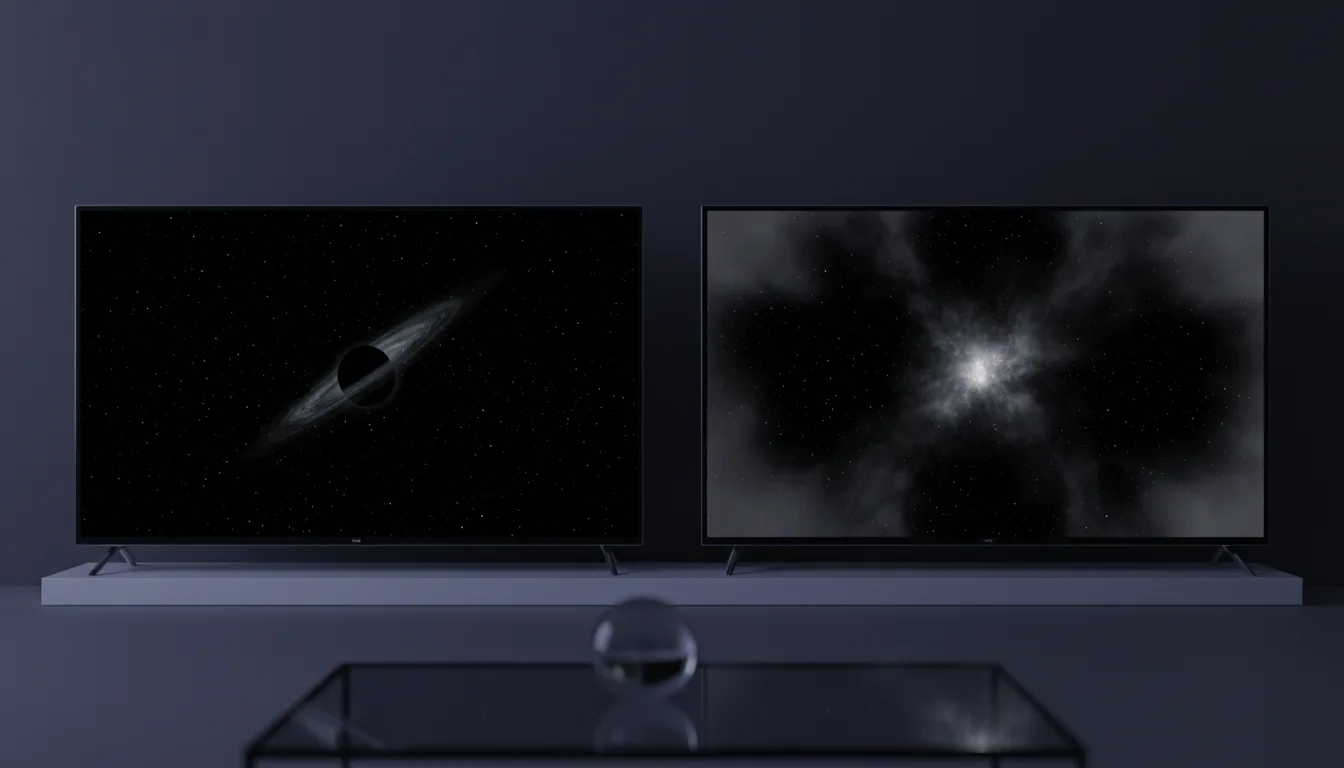
The Core Difference: Light Control
OLED and Mini-LED approach the same problem -- reproducing a realistic image -- from opposite directions. Understanding this fundamental difference explains every strength and weakness of each technology.
OLED uses self-emissive pixels. Each of the 8.3 million pixels produces its own light and can turn off completely. When a pixel is off, it produces zero light. True black. No blooming. No glow around bright objects in dark scenes. The LG C5 delivers infinite contrast because the ratio between its brightest pixel and its darkest pixel is literally immeasurable.
Mini-LED uses a backlight with hundreds or thousands of individually controllable zones behind an LCD panel. When a zone dims, it dims the backlight for that area -- but light bleeds between zones. This creates "blooming" -- a faint halo around bright objects on dark backgrounds. The TCL QM7K with 1000+ zones minimizes this, but it never fully disappears.
Where OLED Wins Decisively
Dark Room Movie Watching
In a dark room, OLED is untouchable. Letterboxed movies with black bars look perfectly black -- not dark gray, not subtly glowing, but actually black. Star fields in space movies show pinpoint bright stars against true darkness. No Mini-LED, regardless of zone count, replicates this.
Gaming Response Time
OLED pixels switch states in under 1 millisecond. LCD pixels (used in Mini-LED) take 4-8ms even on fast panels. For competitive gaming, that difference translates to cleaner motion and less ghosting behind fast-moving objects. The C5's four HDMI 2.1 ports with VRR support make it the default choice for serious gamers.
Viewing Angles
OLED maintains accurate color and contrast from extreme viewing angles -- 60 degrees off-center with minimal degradation. Most Mini-LED TVs use VA panels that wash out noticeably at 25-30 degrees. If your couch seats four people across a wide arc, OLED looks consistent for everyone. Mini-LED looks best for the person sitting dead center.
Walk past a display wall at Best Buy and watch the Mini-LED TVs shift in contrast as you move. Then do the same with an LG OLED. The difference in off-axis performance is immediate and obvious -- no specs needed.
Where Mini-LED Fights Back
Peak Brightness
This is Mini-LED's strongest advantage. The Hisense U75QG hits approximately 1800 nits. The TCL QM8K reaches around 2500 nits. The standard LG C5 peaks at roughly 1000 nits. In HDR content with bright specular highlights -- explosions, sunlight reflections, neon signs -- that extra brightness makes highlights pop more aggressively.
The LG G5 with tandem OLED narrows this gap significantly, reaching approximately 1800 nits by stacking two OLED layers. But it commands a premium price to get there.
Bright Room Performance
In a living room with large windows, Mini-LED's higher sustained brightness fights ambient light more effectively. Samsung's QN70F combines Mini-LED brightness with the industry's best anti-reflection coating -- a combination OLED simply cannot match for daytime viewing.
No Burn-In Risk
Mini-LED uses LED backlights behind LCD, with no organic compounds that degrade unevenly. Burn-in is physically impossible. OLED burn-in risk is low under normal use (see our burn-in guide), but it exists. For commercial displays, hotel rooms, or TVs displaying static content for hours daily, Mini-LED eliminates that concern entirely.
Price
Mini-LED TVs start at the budget-friendly tier for entry models and scale up. OLED starts at the upper mid-range tier. At 65 inches, the TCL QM6K costs a fraction of the LG 65" C5 while offering 144Hz gaming and solid HDR performance. The value gap is real.
The Closeout Exception: The LG C4 at clearout pricing brings OLED into the same price tier as premium Mini-LED TVs. If you find one in stock, it delivers 90%+ of the C5 experience at a significant discount.
Head-to-Head: Decision Scenarios
Scenario 1: Dark Home Theater
OLED wins. Perfect blacks, no blooming, infinite contrast. This is OLED's native habitat. Even an entry-level OLED outperforms a flagship Mini-LED in a completely dark room.
Scenario 2: Bright Living Room with Windows
Mini-LED wins. Higher sustained brightness plus anti-reflection coatings (especially Samsung's) handle ambient light better. The brightness advantage is most noticeable during daytime viewing.
Scenario 3: Mixed Use (Movies + Gaming + Sports)
OLED edges it. The response time advantage for gaming, combined with excellent motion handling for sports and perfect contrast for movies, makes OLED the more versatile performer. Mini-LED is the better pick only if the room stays bright.
Scenario 4: Budget-Conscious Buyer
Mini-LED wins. If the price gap between OLED and Mini-LED means choosing between a premium Mini-LED with 1000+ zones versus an entry OLED, the flagship Mini-LED may deliver a more rounded experience -- especially if the room isn't consistently dark.
The single best indicator of which technology suits you: how dark is your room when you watch? If you typically watch with lights off or dimmed, OLED's contrast advantage is maximized. If you watch with overhead lights on or during the day, Mini-LED's brightness advantage takes over.
The Bottom Line
OLED is worth it if you value contrast, viewing angles, and gaming response time -- and your room is at least moderately dim during viewing. The LG C5 is the recommendation for most buyers who can afford the step up.
Mini-LED is the smarter buy if you prioritize brightness, want a larger screen size for less money, or watch primarily in a bright room. The TCL QM7K represents the sweet spot where Mini-LED performance approaches OLED-level quality in HDR.
Both technologies are excellent in 2026. The gap between them is smaller than ever. And either one is a massive upgrade from a standard LED or QLED panel without local dimming.
Frequently Asked Questions
Is OLED worth it over Mini-LED for gaming?
Yes, for most gamers. OLED delivers sub-1ms response times, zero motion blur, and infinite contrast that makes dark game scenes look stunning. The LG C5 has four HDMI 2.1 ports for multi-console setups. Mini-LED is the better choice only if you play primarily in bright rooms where raw brightness matters more than contrast.
How much more does OLED cost than Mini-LED?
At 55 inches, OLED starts at the upper mid-range tier while competitive Mini-LED TVs start at the value-priced tier. At 65 inches, the gap narrows. The LG C4 at closeout pricing brings OLED closer to premium Mini-LED territory.
Will OLED burn-in ruin my TV?
Modern OLED TVs have pixel-refresh algorithms, brightness limiters, and logo-detection features that make burn-in extremely unlikely under normal viewing habits. LG warranties cover burn-in for the first few years. Burn-in is a realistic concern only for commercial signage or 24/7 static content display.
Is Mini-LED better than OLED for movies?
For dark room movie watching, OLED wins. Perfect blacks and per-pixel dimming create contrast that no Mini-LED can match. For bright room viewing or HDR content with specular highlights (explosions, sunlight, neon signs), Mini-LED's higher peak brightness makes those highlights more impactful.
Should I wait for next-gen OLED or buy now?
The LG C5 and G5 represent a mature, excellent generation of OLED. Tandem OLED (G5) already addresses the brightness gap. Waiting another year might save modest money on closeout pricing, but the current generation is excellent and widely available.
Can OLED get bright enough for a sunny room?
Standard OLED (C5) peaks around 1000 nits, which handles moderate ambient light. The G5 with tandem OLED reaches approximately 1800 nits -- competitive with many Mini-LEDs. For rooms with floor-to-ceiling windows and direct sunlight, Mini-LED with anti-reflection coatings (like Samsung's QN70F) still has an edge.