LED vs QLED vs Mini-LED vs OLED Explained
Four panel technologies. Dozens of marketing terms. One question: which one produces the best picture for your budget and room? This guide cuts through the branding noise and explains what each technology actually does — how the backlight works, why contrast ratios differ, and which tech fits which scenario. No jargon without explanation.
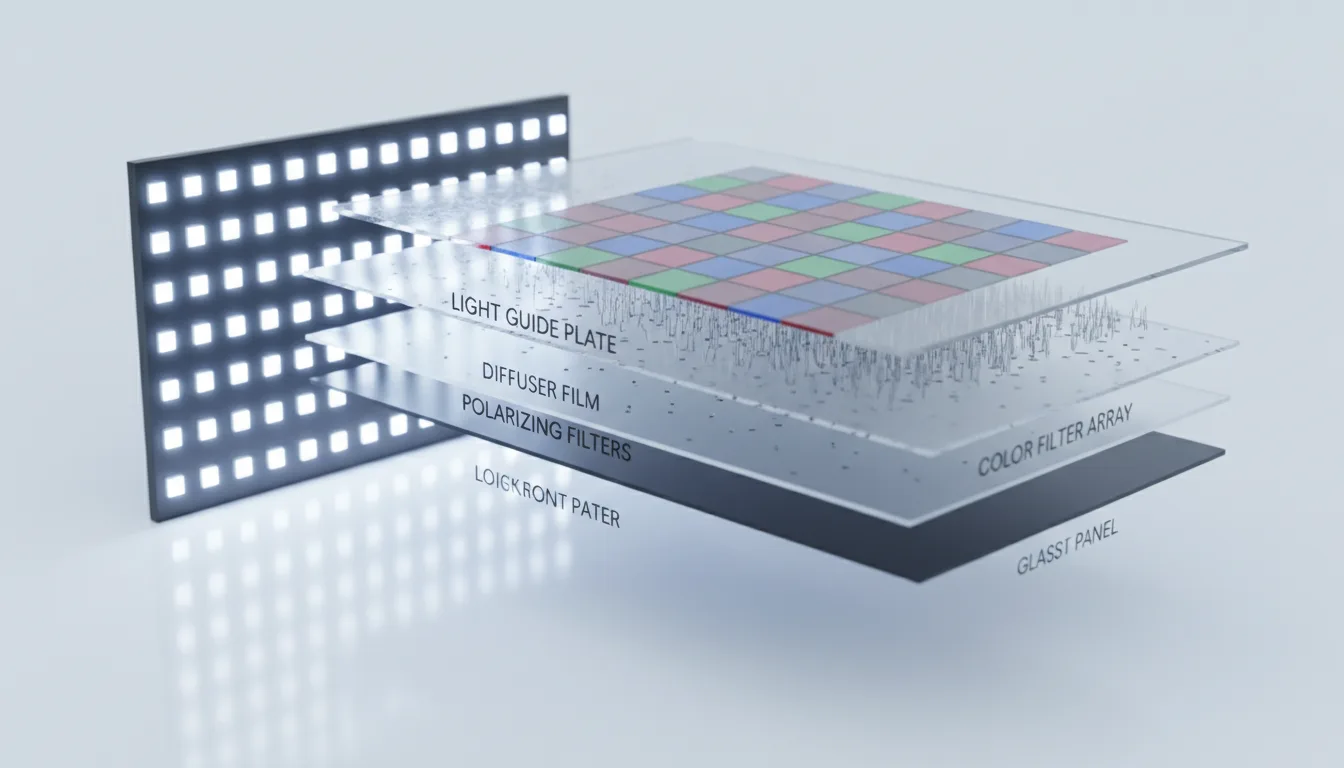
How TV Panels Work: A 30-Second Primer
Every non-OLED TV works on the same basic principle: a backlight produces white light, an LCD layer blocks or passes portions of that light, and color filters create the image you see. The differences between LED, QLED, and Mini-LED come down to what produces the backlight, how many backlights there are, and how precisely they can be controlled.
OLED breaks this model entirely. Each pixel produces its own light — no backlight needed. When a pixel should be black, it simply turns off.
LED: The Baseline
Standard LED TVs use a row of LEDs along the edge of the panel (edge-lit) or a grid across the back (direct-lit) to illuminate the LCD layer. This is the simplest, cheapest, and most common technology. Every TV in the budget category uses standard LED backlighting.
Strengths
- Lowest cost — sub-$300 for a 55-inch 4K panel
- Decent brightness for well-lit rooms
- Reliable with minimal maintenance concerns
- Thin profiles, especially edge-lit models
Weaknesses
- Limited contrast — blacks look gray in dark rooms because the backlight bleeds through
- Narrow color gamut compared to quantum dot panels
- Edge-lit models suffer from uneven brightness (brighter edges, dimmer center)
- No local dimming at budget prices, meaning the entire screen brightens or dims together
LED TVs make sense when the room is bright enough that deep blacks do not matter, when the TV is for a secondary room (bedroom, kitchen, guest room), or when budget is the primary constraint. A well-chosen LED TV in a bright room can look just as good as a QLED in the same conditions.
Representative pick: The Insignia 55" Fire TV at Under $300 is a straightforward example of what budget LED delivers — decent 4K streaming in a simple package.
QLED: LED With Better Color
QLED places a quantum dot film between the LED backlight and the LCD panel. Quantum dots convert the backlight into more saturated colors, expanding the color gamut by 20-30% over standard LED. Samsung popularized the QLED branding, but TCL, Hisense, and others use the same technology under different names (Hi-QLED, QNED, etc.).
Strengths
- Wider color gamut — more vivid, accurate colors especially in reds and greens
- Higher peak brightness than standard LED, typically 500-800 nits vs 250-400
- Better HDR performance thanks to improved brightness and color volume
- Available at competitive mid-range prices from TCL, Hisense, and Roku
Weaknesses
- Same backlight limitations as LED — blacks are still not true black
- Without local dimming, contrast ratio is similar to standard LED
- Samsung charges a premium for the QLED branding that competitors undercut
- Not a different panel technology — still LCD with LED backlight, just enhanced color
Representative pick: The Roku 65" Pro Series combines QLED with local dimming and 120Hz at a competitive mid-range price — a strong example of what QLED delivers when paired with proper dimming.
Mini-LED: QLED With Precision Dimming
Mini-LED is the most significant backlight upgrade in the LCD lineage. Instead of dozens of standard LEDs, Mini-LED panels pack thousands of tiny LEDs into the backlight array. These tiny LEDs form hundreds or thousands of independently controlled dimming zones, allowing specific areas of the screen to brighten or dim without affecting adjacent areas.
The result: contrast ratios that approach OLED territory in well-implemented panels. A bright explosion against a dark sky actually looks bright against dark, rather than bright against slightly-less-bright.
Strengths
- Dramatically better contrast than LED or QLED — dark scenes look properly dark
- Higher peak brightness than OLED — some models exceed 2,000 nits in HDR highlights
- Excellent HDR performance with precise highlight/shadow separation
- Prices have dropped 30-40% since 2024, making this technology accessible at mid-range budgets
Weaknesses
- Blooming — bright objects on dark backgrounds can create a visible halo of light leaking from adjacent zones
- Zone count matters enormously. A 100-zone Mini-LED and a 2,000-zone Mini-LED are worlds apart in performance
- Still uses LCD panel, so viewing angles are narrower than OLED
- Premium Mini-LEDs can approach OLED pricing, reducing the value advantage
The zone count rule of thumb: Below 200 zones, dimming is coarse and blooming is obvious. Between 200-500 zones, dimming is good for most content. Above 500 zones, you are approaching near-OLED precision. Above 1,000 zones, diminishing returns set in — the jump from 1,000 to 2,000 is far less visible than from 200 to 500.
Representative pick: The Hisense 65" U75QG delivers Mini-LED performance with extensive dimming zones at a price point that undercuts most competitors. Our top value recommendation in the category.
OLED: Self-Emissive Perfection (With Trade-Offs)
OLED (Organic Light-Emitting Diode) eliminates the backlight entirely. Each pixel is a tiny organic LED that produces its own light. When a pixel needs to be black, it turns off completely. Zero light. Infinite contrast ratio. This fundamental difference is why OLED blacks look "inky" and why Mini-LED blacks — even great ones — still look slightly gray in direct comparison.
Strengths
- Perfect blacks — pixel-level dimming means true zero-light black levels
- Infinite contrast ratio in any lighting condition
- Widest viewing angles of any panel technology — colors stay accurate even at 60+ degrees off-axis
- Near-instantaneous pixel response time — excellent for gaming with virtually no motion blur
- Thinnest profiles, since there is no backlight layer
Weaknesses
- Lower peak brightness than top Mini-LEDs — most OLEDs cap at 800-1,500 nits vs 2,000+ for flagship Mini-LEDs
- Higher price — OLED TVs command a significant premium over equivalent-size Mini-LEDs
- Burn-in risk with extreme static content (modern mitigation largely addresses this for typical use)
- Available in fewer sizes — most OLED options are 55" and 65", with limited 77" and 83" offerings
The lower peak brightness does not mean OLED is unusable in bright rooms — modern OLEDs with anti-reflective coatings handle ambient light better than you might expect. But in a room with direct sunlight hitting the screen, a Mini-LED with 1,500+ nits will maintain visible HDR highlights where an OLED's specular highlights start to wash out.
Representative pick: The LG 55" OLED C5 is the OLED to beat in 2026. Perfect blacks, 120Hz gaming, and LG's mature webOS platform make it the go-to for home theater enthusiasts.
Head-to-Head: Which Technology Wins Where?
| Category | LED | QLED | Mini-LED | OLED |
|---|---|---|---|---|
| Black Levels | Fair | Fair | Good | Perfect |
| Peak Brightness | Low | Good | Excellent | Good |
| Color Gamut | Standard | Wide | Wide | Widest |
| Viewing Angles | Narrow | Narrow | Moderate | Wide |
| Price Range | Lowest | Mid | Mid-High | Highest |
| Best For | Budget | Bright rooms | Best value | Home theater |
Common Mistakes When Choosing Panel Technology
1. Assuming QLED = OLED
Samsung's QLED branding intentionally echoes OLED. They are fundamentally different. QLED is an enhanced LCD. OLED is self-emissive. The confusion benefits Samsung's marketing, but not your purchase decision.
2. Overpaying for Mini-LED With Low Zone Count
A "Mini-LED" TV with 50 dimming zones barely improves on standard LED contrast. The technology delivers its promise at 200+ zones. Check the spec sheet, not just the marketing label.
3. Buying OLED for a Bright Room
OLED's perfect blacks are most visible in dim environments. In a room flooded with daylight, those perfect blacks become irrelevant because ambient light raises the perceived black level anyway. A bright Mini-LED will look better than an OLED in strong ambient light.
4. Ignoring the Full-Array vs Edge-Lit Distinction
Two QLEDs can have the same quantum dot color enhancement but vastly different contrast performance. A full-array backlit QLED with local dimming vastly outperforms an edge-lit QLED. Always check backlighting type, not just the quantum dot claim.
Frequently Asked Questions
What is the difference between LED and QLED?
Is OLED better than Mini-LED?
What is a quantum dot?
Why are OLED TVs more expensive?
What does "dimming zones" mean on a Mini-LED TV?
Will OLED burn-in ruin my TV?
Is QLED the same as OLED?
Pick Your Technology, Then Pick Your TV
Start with the room: bright room with lots of windows favors Mini-LED. Dedicated dark home theater favors OLED. Budget secondary room favors LED or entry QLED. Once you know your panel type, browse our category roundups for ranked picks: Budget LED, QLED, Mini-LED, and OLED.